Search the Blog
Categories
- Books & Reading
- Broadband Buzz
- Census
- Education & Training
- General
- Grants
- Information Resources
- Library Management
- Nebraska Center for the Book
- Nebraska Memories
- Now hiring @ your library
- Preservation
- Pretty Sweet Tech
- Programming
- Public Library Boards of Trustees
- Public Relations
- Talking Book & Braille Service (TBBS)
- Technology
- Uncategorized
- What's Up Doc / Govdocs
- Youth Services
Archives
Subscribe
Author Archives: Emily Nimsakont
Friday Reads: Fahrenheit 451 by Ray Bradbury
“Somewhere the saving and putting away had to begin again and someone had to do the saving and keeping, one way or another, in books, in records, in people’s heads, any way at all so long as it was safe, free from moths, silver-fish, rust and dry-rot, and men with matches.”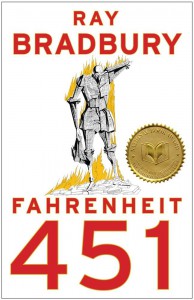
I find it somewhat hard to believe that I haven’t read Fahrenheit 451 until now. In addition to its status as a classic, it would seem that, given, my chosen profession, I’d have managed to read it already. As the above quote illustrates, the message of this book should appeal to librarians.
Before I started reading this book, I was familiar with the general premise, a dystopian future in which books are outlawed. The book’s protagonist is Guy Montag, who works as a fireman. In this future society, firemen don’t put out fires; they set them, in order to burn illicit books. Montag becomes increasingly dissatisfied with the state of the society in which he lives, and he takes steps to oppose the status quo.
I’ve been very pleasantly surprised at how much I’m enjoying finding out all the details of this book that has existed in my consciousness only as a cultural icon all this time. I think it is very well-written, and I love Bradbury’s prose. Although the book was originally published in the 1950s, I find many of its descriptions of everyday life and technology very similar to our current society. Reading about how, instead of interacting with one another, people focus their attention on televisions that take up three walls of their living rooms and constantly listen to earphones made me feel guilty about the amount of time I spend mindlessly using my TV, tablet, and iPod. (However, I did use my iPod to listen to this audiobook, so maybe electronic devices are not all bad!)
The particular audiobook I am listening to is narrated very well by actor Tim Robbins, which adds to my enjoyment. Robbins does a great job of bringing Montag to life and provides distinguishable, believable voices for the supporting characters.
Bradbury, Ray. Fahrenheit 451. Newark, NJ: Audible Studios, 2014.
Just Like Riding a Bike
You may not have realized that May is National Bike Month, though I suppose it makes sense to get out and enjoy the spring weather on your bicycle. The first verifiable invention of the bicycle occurred in the 1800s, and as a glance through Nebraska Memories shows, Nebraskans have been enjoying their bikes for many years.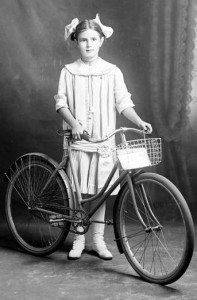
The Butler County Gallery Collection includes some portraits of children posed with their bicycles, such as Elvannah Brown. While she is technically riding a tricycle, rather than a bicycle, this image of toddler Nettie Butler 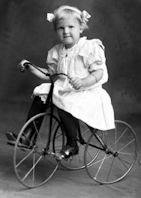 was too adorable not to include.
The Townsend Studio Collection also includes some portraits of people with their bikes. This portrait of Mrs. Tomas Bennett most likely depicts a bicycle used for purely recreational purposes, while Ed Mockett’s portrait depicts a cyclist and his racing bike.
A less formal, and more recent, depiction of a bicycle is shown in this image of children at 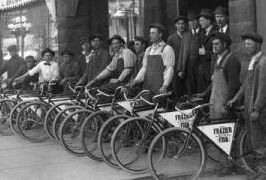 the Nebraska Children’s Home in Omaha receiving a bike, among other gifts, in 1938. Also of interest is a group of images of the Frazier Cycle Company in Omaha in the early 1900s.
Visit Nebraska Memories to search for or browse through many more historical images digitized from photographs, negatives, postcards, maps, lantern slides, books and other materials.
Nebraska Memories is a cooperative project to digitize Nebraska-related historical and cultural heritage materials and make them available to researchers of all ages via the Internet. Nebraska Memories is brought to you by the Nebraska Library Commission. If your institution is interested in participating in Nebraska Memories, see http://nlc.nebraska.gov/nebraskamemories/participation.aspx for more information, or contact Devra Dragos, Technology & Access Services Director.
Posted in Nebraska Memories
Leave a comment
If Pinterest Existed…
The popular website Pinterest describes itself as a “visual discovery tool”. Nebraska Memories also allows for discovery based on visual resources.
Can you imagine what it would be like if Pinterest existed when some of these photographs were taken? I took a moment to let my imagination roam and come up with some Pinterest-esque caption for these great images. Once I got going, I discovered that Nebraska Memories hits several of the major categories you will find on Pinterest today: parties, food, fashion, kids, décor, and of course, cats!

Just like an image on Pinterest can lead you to a great recipe or DIY project, an image in Nebraska Memories can lead you to an interesting story about Nebraska’s past. Visit Nebraska Memories to search for or browse through many more historical images digitized from photographs, negatives, postcards, maps, lantern slides, books and other materials.
Nebraska Memories is a cooperative project to digitize Nebraska-related historical and cultural heritage materials and make them available to researchers of all ages via the Internet. Nebraska Memories is brought to you by the Nebraska Library Commission. If your institution is interested in participating in Nebraska Memories, see http://nlc.nebraska.gov/nebraskamemories/participation.aspx for more information, or contact Beth Goble, Historical Services Librarian, or Devra Dragos, Technology & Access Services Director.
Posted in Nebraska Memories
Leave a comment
Friday Reads: Funny Girl by Nick Hornby
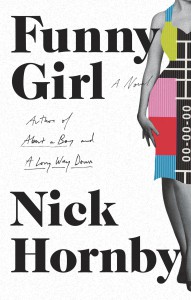 It’s been almost five years since Nick Hornby released a novel, and I have been waiting eagerly for this one. So far, it has not disappointed me. While most of Hornby’s other works are contemporary fiction, Funny Girl is set in the 1960s. It follows Barbara Parker (or Sophie Straw, once she starts using a stage name) as she rises from a small-town beauty queen with a desire to make people laugh to a national television comedy star. The book explores the theme of light entertainment versus serious art and the importance of each.
Though many of Hornby’s earlier books, such as High Fidelity and About a Boy, are considered to be targeted toward men, I enjoy his books in general. I think that Funny Girl in particular will appeal to both male and female readers. I’m looking forward to reading more.
Hornby, Nick. Funny Girl. New York: Riverhead Books, 2015.
A Cup of Tea
 We are having balmy January days here in Nebraska, but people in colder parts of the country may be glad to know that January is National Hot Tea Month. While there are only a few days left in the month, a hot cup of tea is always a good way to ward off the winter chill. A look through Nebraska Memories reveals that tea has been a part of people’s lives for many years.
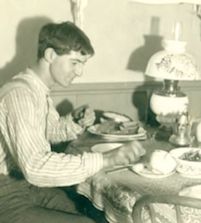
Tea cups are featured on this Fremont family’s table as they gather in their kitchen for a meal. Photographs from the William Wallace residence in Omaha show a tea kettle in the kitchen and silver tea sets 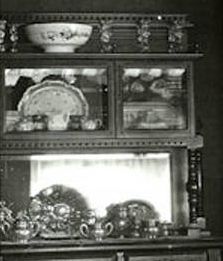 in the dining room and parlor.
Although there may not have been actual tea involved, in my opinion, some of the sweetest tea-related pictures in Nebraska Memories are the images of children having tea parties. There are several posed portraits of children with tea sets in the Butler County Gallery collection, including this photograph of Dorothy Rich sitting with a doll and a stuffed bunny. The 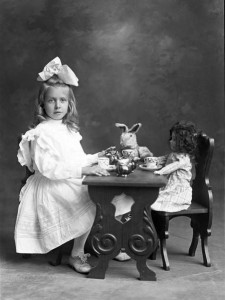 Nebraska State Historical Society collection includes a less formal image of children playing with a tea set in a barn.
Visit Nebraska Memories to search for or browse through many more historical images digitized from photographs, negatives, postcards, maps, lantern slides, books and other materials.
Nebraska Memories is a cooperative project to digitize Nebraska-related historical and cultural heritage materials and make them available to researchers of all ages via the Internet. Nebraska Memories is brought to you by the Nebraska Library Commission. If your institution is interested in participating in Nebraska Memories, see http://nlc.nebraska.gov/nebraskamemories/participation.aspx for more information, or contact Beth Goble, Historical Services Librarian, or Devra Dragos, Technology & Access Services Director.
Posted in Nebraska Memories
Leave a comment
Friday Reads: The Miseducation of Cameron Post by Emily M. Danforth
 The small town of Miles City, Montana, serves as the setting for this coming-of-age novel. It takes place in the early 1990s and follows its protagonist, Cameron from age 12 to age 16, so it definitely has nostalgic appeal for someone like me, who was also in junior high and high school in the early 90s.
The book revolves around two major occurrences in Cameron’s life: the death of both of her parents in a car accident and her growing awareness of the fact that she is gay.
This is a well-written book that vividly creates the setting of rural Montana. The author holds a Ph. D. from UNL, though I was unaware of that Nebraska connection when I started the book. I am about halfway finished listening to the audiobook version of this title, and I’m looking forward to the rest.
Danforth, Emily M. The Miseducation of Cameron Post. Newark, NJ: Audible Studios, 2013.
Introduction to MarcEdit Class Offered in February
Do you want to do more with your MARC records? Are you looking for an easy way to add or delete fields, split a batch of records into several groups, or extract particular fields to create a report? Attend this workshop to learn how to do all of these tasks and more with free MarcEdit software.
Audience: Library staff with some knowledge of AACR2/RDA, MARC records, and cataloging.
This workshop is approved for the NLC Cataloging Certificate Program.
Date: February 27, 2015
Time: 9:00 AM-12:00 PM
Location: Bellevue University Library, Classroom 460
Capacity: 10 participants
CE Hours: 3
To register, go to the Nebraska Library Commission Training and Events Calendar.
Posted in Education & Training
Leave a comment
Movember, Nebraska Memories Style
Movember is an annual event during which men are encouraged to grow mustaches during the month of November in order to raise awareness of men’s health issues. A glance at the photo gallery on the Movember website reveals some of the striking mustaches grown in support of the cause. The Movember movement started in 2003, but men have been sporting notable mustaches for ages. A number of these mustaches are documented in Nebraska Memories.
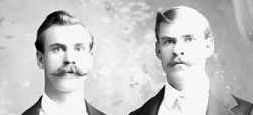 Many of these Nebraskan mustaches are showcased in the portraits of the Butler County Gallery Collection. Ralph Stryker and George Hahn were two men who sat for portraits in the early 1900s, both showing off their mustaches. Growing mustaches (and beards) was clearly a family affair for the four Smith brothers of David City.
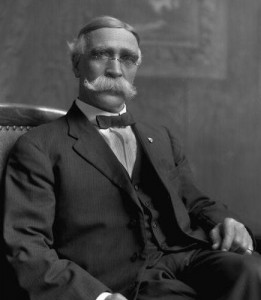 Another notable mustache portrait is found in the Townsend Studio collection. Henry Herpolsheimer, president of Lincoln’s Herpolsheimer Company, sports a long white mustache in his portrait. Joseph M. Rising, a member of the founding family of Rising City, also has a bushy mustache.
While most of these mustache photographs date from the late 1800s or early 1900s, interesting mustaches can be found in later photos as well. This German prisoner of war, in a photograph 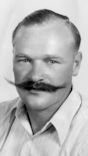 taken at Camp Atlanta, near Holdrege, during World War II, has a prominent mustache.
Visit Nebraska Memories to search for or browse through many more historical images digitized from photographs, negatives, postcards, maps, lantern slides, books and other materials.
Nebraska Memories is a cooperative project to digitize Nebraska-related historical and cultural heritage materials and make them available to researchers of all ages via the Internet. Nebraska Memories is brought to you by the Nebraska Library Commission. If your institution is interested in participating in Nebraska Memories, see http://nlc.nebraska.gov/nebraskamemories/participation.aspx for more information, or contact Beth Goble, Historical Services Librarian, or Devra Dragos, Technology & Access Services Director.
Posted in Nebraska Memories
Leave a comment
You Can Take It To The Bank
The first bank in Nebraska was established even before Nebraska became a state. The Kountze Brothers Bank was opened in Omaha in 1857, when Nebraska was still a territory. It later became First National Bank of Omaha. As more and more of Nebraska was settled, more banks were established. Nebraska Memories contains many images of banks in 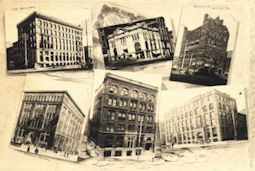 Nebraska cities and towns, from many different points in the history of the state.
First National was just one of many banks in Omaha. This print from the 1880s shows five different Omaha banks, only a few of the city’s banking institutions.
Of course, smaller towns in Nebraska had banks, too. The bank in Sidney in 1900 shared a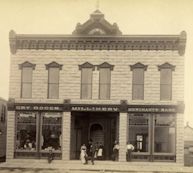 stone building with a dry goods store and a millinery shop. This image of the Bank of
 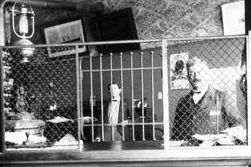 Brainard gives us a glimpse into the interior of an early twentieth century bank.
A slightly more recent picture, from the 1920s, shows a bank in Richfield, Nebraska. My 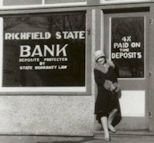 co-workers and I were commenting that the four percent interest rate advertised in the window is better than what we are currently receiving on our accounts!
Visit Nebraska Memories to search for or browse through many more historical images digitized from photographs, negatives, postcards, maps, lantern slides, books and other materials.
Nebraska Memories is a cooperative project to digitize Nebraska-related historical and cultural heritage materials and make them available to researchers of all ages via the Internet. Nebraska Memories is brought to you by the Nebraska Library Commission. If your institution is interested in participating in Nebraska Memories, see http://nlc.nebraska.gov/nebraskamemories/participation.aspx for more information, or contact Beth Goble, Historical Services Librarian, or Devra Dragos, Technology & Access Services Director.
Posted in Nebraska Memories
2 Comments
Authority Control class offered online in October
Libraries use authority control to manage the names, uniform titles, series, and subject headings in their catalogs. Participants in this class will learn what authority control is and why it is needed, how to read a MARC authority record, and how to use the Library of Congress authority file. The class will also include discussion of how to keep headings in your local systems up-to-date, and the relevance of authority control in “Next Generation” catalogs and discovery layers.
Audience: Library staff with some knowledge of AACR2/RDA, MARC records, and cataloging.
This workshop is approved for the NLC Cataloging Certificate Program.
CE Hours: 5
This class will be held online from October 27 to December 5. Class participants will access the course web site in order to read materials and complete projects and assignments. The class is held asynchronously, which means that participants are not required to be online at any particular time during the five weeks; however, there is a class schedule with due dates that participants are expected to meet. The instructor will interact with the participants during the course to offer feedback and provide explanations of material.
To register, go to the NLC Training and Events Calendar.
Posted in Education & Training
Leave a comment
RDA Revisited class offered in Bellevue and Hastings in September
 It’s been almost a year and a half since the national libraries (and many others) implemented Resource Description and Access (RDA) as their cataloging code. Attend this class to learn about updates that have been made to RDA since implementation and discuss the realities of cataloging (both original and copy) with RDA. The workshop will include time for hands-on creation of RDA records for a variety of items, exploration of the RDA Toolkit, and discussion about where RDA fits in the future of cataloging.
Audience: Library staff with some knowledge of AACR2/RDA, MARC records, and cataloging.
Lunch is on your own.
This workshop is approved for the NLC Cataloging Certificate Program.
CE Credits: 6
Location: Bellevue University
Date: September 19, 2014
Time: 9AM-4PM Central Time
Cost: No Charge
Capacity: 30
To register, visit the NLC Training and Events Calendar.
Location: Hastings Public Library
Date: September 23, 2014
Time: 9:30AM-4:30PM Central Time
Cost: No Charge
Capacity: 20
To register, visit the NLC Training and Events Calendar.
Posted in Education & Training
3 Comments
Friday Reads: Redeployment by Phil Klay
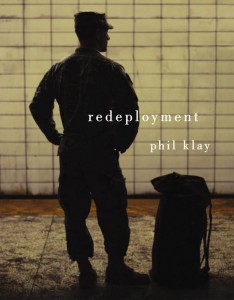 Phil Klay served in the Iraq War as a United States Marine and then earned his MFA degree. In this book, Klay’s short stories reflect the experiences of those who served in Iraq, both during deployments and upon returning home. He explores the harsh realities of war, but the sadness is tempered with humor, and I’m finding it very engrossing so far.
Klay, Phil. Redeployment. Penguin Press, 2014.
Rising City Memories
An assortment of items from Rising City Community Library joins Nebraska Memories as its newest collection. The photographs and postcards in the collection highlight many aspects of Rising City’s history.
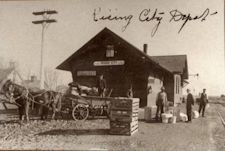 Rising City was established when the Omaha & Republican Valley Railroad was extended across Butler County in 1878, and the collection includes photographs that show the town’s railroad roots. In this photograph, the town’s railroad depot appears to be a site of bustling activity.
The establishment of the railroad brought increased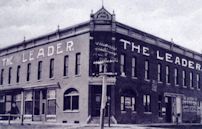 population to the area, and businesses grew accordingly. The business community of Rising City is well represented in this collection. Images of local businesses, including a hotel, banks, and a meat market, provide a
 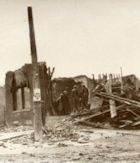 view into Rising City’s business scene throughout its history. One of the most notable commercial buildings in Rising City was a prominent brick building known as the Opera Block. This structure was built in 1892, and it was destroyed by fire in 1923. This collection includes scenes of the destroyed building after the fire.
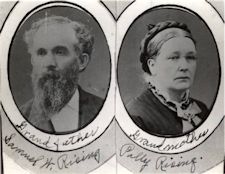 A group of portraits of members of the Rising family, after whom the town is named, is another highlight of this collection. Samuel W. Rising (seen here with his wife Polly) and his son Albert W. Rising each gave 40 acres of their land to be used for the Rising City town site. Portraits of Samuel’s other sons, Dennis and Joseph, are in the collection, as well.
Take a moment and explore this collection to get a glimpse into Rising City history, and be sure to visit Nebraska Memories to search for or browse through many more historical images digitized from photographs, negatives, postcards, maps, lantern slides, books and other materials.
Nebraska Memories is a cooperative project to digitize Nebraska-related historical and cultural heritage materials and make them available to researchers of all ages via the Internet. Nebraska Memories is brought to you by the Nebraska Library Commission. If your institution is interested in participating in Nebraska Memories, see http://nlc.nebraska.gov/nebraskamemories/participation.aspx for more information, or contact Beth Goble, Historical Services Librarian, or Devra Dragos, Technology & Access Services Director.
Posted in Nebraska Memories
2 Comments
Dewey Decimal Classification Class Offered in July
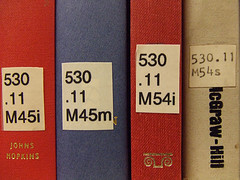
Photo Credit: jasonvance via Compfight cc
Does this book on houseplants go in gardening (635.9), botany (581.6), or interior decorating (747)? If you have a nodding acquaintance with Abridged Dewey Decimal Classification and Relative Index but would like to feel more comfortable using this important tool, join us for a series of three one-and-a-half-hour online sessions. Sessions will include discussion on assigning classification numbers when a topic might fall under more than one discipline, choosing the right number based on Notes and Manual entries, building numbers using the tables, and a look at OCLC’s Abridged WebDewey. This workshop is approved for the NLC Cataloging Certificate Program.
Prerequisite: Basic Skills Organization of Library Materials or some library experience.
Dates: July 8, 15, and 22, 2014
Time: 10:00-11:30 am Central Time
Cost: No Charge
CE Hours: 4.5
To register, visit the NLC Training and Events Calendar.
Posted in Education & Training
Leave a comment
Celebrating Easter
This Sunday is Easter, the Christian celebration of the resurrection of Jesus. For many people, the holiday also holds the connotation of celebrating spring and new life. Nebraska Memories includes items that relate to many aspects of Easter celebration.
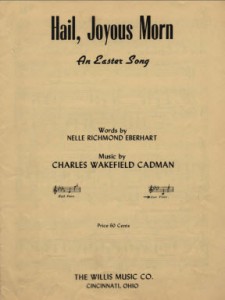 For Christians, church services are clearly an important part of Easter, and music is generally involved in worship. The Polley Music Library collection contains scores of two pieces of Easter music, Gradual for Easter Sunday and Hail, Joyous Morn: An Easter Song.
Easter egg hunts are another traditional way to celebrate the holiday. This photograph from the Nebraska Children’s Home Society collection shows kids at a children’s home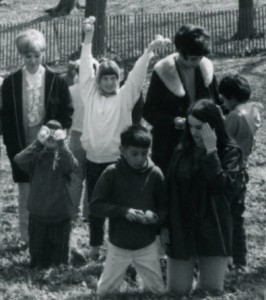 enjoying an egg hunt in the 1950s or 1960s.
Traditionally, Easter has also been a time for dressing up. New Easter dresses and, of course, Easter bonnets are common purchases. This advertisement from a program for a symphony orchestra concert (another item in the Polley Music Library collection) touts Magee’s as the 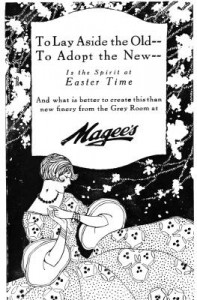 place to obtain Easter finery.
Visit Nebraska Memories to search for or browse through many more historical images digitized from photographs, negatives, postcards, maps, lantern slides, books and other materials.
Nebraska Memories is a cooperative project to digitize Nebraska-related historical and cultural heritage materials and make them available to researchers of all ages via the Internet. Nebraska Memories is brought to you by the Nebraska Library Commission. If your institution is interested in participating in Nebraska Memories, see http://nlc.nebraska.gov/nebraskamemories/participation.aspxfor more information, or contact Beth Goble, Historical Services Librarian, or Devra Dragos, Technology & Access Services Director.
Posted in Nebraska Memories
Leave a comment
UNL Libraries Visiting Scholar Program on Research Sharing, April 22
The University of Nebraska–Lincoln Libraries invites you to a lecture and panel discussion on Tuesday, April 22, 2014, provided by the 2014 Visiting Scholar.
Dr. Karla Strieb, a librarian and faculty member at the Ohio State University, will look at current trends and developments in the evolving environment for research sharing. Funder requirements for sharing research findings and even research data continue to increase, especially when taxpayers are footing the bill. The implications and options for research libraries to advance research sharing will be discussed using the experiences of the Ohio State University to highlight issues and opportunities.
The lecture: “The Times, They are a-Changin’: Funder Requirements for Research Sharing” is scheduled at 10:00 a.m. in Room 202 in the Jackie Gaughan Multicultural Center on the University of Nebraska-Lincoln City campus.
At 2:00 p.m. in the afternoon, also in Room 202, Dr. Strieb will be joined by a panel of University of Nebraska faculty and administrators to discuss current efforts at UNL to comply with the mandate.
Both the lecture and panel discussion are free and open to the public, so please make plans to join us.
Campus maps:
http://parking.unl.edu/maps/VisitorGuestParkingCityCampus.pdf
For more information, contact:
Ted Naylor
Academic Activities Committee
University of Nebraska-Lincoln Libraries
402-472-3412
tnaylor2@unl.edu
Posted in General
Leave a comment
Valentine’s Day Treats
It’s Valentine’s Day, a day devoted to the celebration of love. Each year on February 14th, many people exchange flowers, candy, or other gifts with the special people in their lives. Go on a shopping spree in Nebraska Memories and explore some of the establishments where these gifts could be purchased through the years.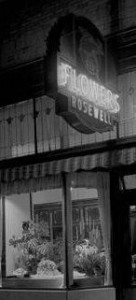
Flowers are a very traditional Valentine’s Day gift. If your significant other lives close to you, you can stop by a local florist, such as the Rosewell Floral Company in Lincoln, to make your purchase. If you are far away from your sweetheart, companies such as FTD can handle long distance deliveries. This photograph of the Wilson Flower Shop in David City shows the FTD logo on their delivery truck.
Candy is another popular choice as a gift for a loved one. A sign in this Omaha candy shop promised quick service; perhaps it was a good place to pick up a last minute gift. The boxed chocolates 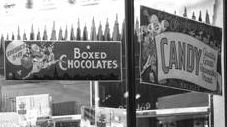 advertised in the window of this store were probably a good choice on Valentine’s Days past.
Giving a gift of jewelry is another way to celebrate the day. This photograph of the interior of a David City jewelry store shows customers browsing at the counter. Borsheim’s jewelry store, shown here at its original location on 16th and Harney Streets in Omaha, surely sold many 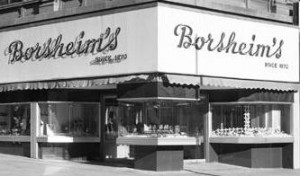 Valentine’s Day gifts through the years.
Visit Nebraska Memories to search for or browse through many more historical images digitized from photographs, negatives, postcards, maps, lantern slides, books and other materials.
Nebraska Memories is a cooperative project to digitize Nebraska-related historical and cultural heritage materials and make them available to researchers of all ages via the Internet. Nebraska Memories is brought to you by the Nebraska Library Commission. If your institution is interested in participating in Nebraska Memories, see http://nlc.nebraska.gov/nebraskamemories/participation.aspx for more information, or contact Beth Goble, Historical Services Librarian, or Devra Dragos, Technology & Access Services Director.
Posted in Nebraska Memories
2 Comments
There’s a Song in the Air
The Christmas season is upon us, and no one can deny that music is an integral part of the Christmas experience. The Polley Music Library collection in Nebraska Memories includes many artifacts relating to the music of Christmases past.
While traditional carols are always popular, every generation creates its own original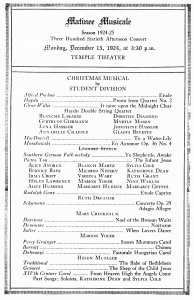 Christmas songs. This piece of sheet music includes two songs composed by Flora Bullock, a professor at the University of Nebraska-Lincoln. The songs, titled Christmas Bells and It is Christmas Again, were published in 1941.
This time of year is often filled with concerts where Christmas music is performed. The Polley collection contains programs from holiday music events, including a Christmas concert sponsored by Lincoln’s Matinee Musicale club in 1924, and a Christmas musicale given for the Lincoln Women’s Club in 1909 by Lillian Helms Polley, the founder of the Polley Music Library.
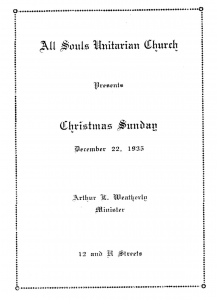 Of course, Christmas music is often heard as part of worship services. The Polley collection includes two bulletins from Christmas Sunday services at All Souls Unitarian Church in Lincoln, from 1935 and 1940. Lillian Helms Polley was the choir director at the church at the time of these services.
Visit Nebraska Memories to search for or browse through many more historical images digitized from photographs, negatives, postcards, maps, lantern slides, books and other materials.
Nebraska Memories is a cooperative project to digitize Nebraska-related historical and cultural heritage materials and make them available to researchers of all ages via the Internet. Nebraska Memories is brought to you by the Nebraska Library Commission. If your institution is interested in participating in Nebraska Memories, see
http://nlc.nebraska.gov/nebraskamemories/participation.aspx for more information, or contact Beth Goble, Historical Services Librarian, or Devra Dragos, Technology & Access Services Director.
Posted in Nebraska Memories
Leave a comment
Honoring Grandparents
Every September, National Grandparents Day is celebrated on the Sunday after Labor Day. This holiday was created by Marian Lucille Herndon McQuade of West Virginia. In 1978, President Jimmy Carter declared it a national holiday. According to the National Grandparents Day website, the purpose of the day is “to honor grandparents, to give grandparents an opportunity to show love for their children’s children, and to help children become aware of the strength, information and guidance older people can offer.”
 Nebraska Memories contains several images of children and their grandparents. The Boston Studio collection includes posed portraits of grandparents and grandchildren together. More informal examples of grandparents spending time with their grandkids can be found in this 1924 photograph of Fred Zeeck and his granddaughter Betty and in this image of a Sioux grandmother
and granddaughter sitting together near a fire. This stereoscopic photograph titled “A Letter to Grandma” shows a young girl sitting at a desk, writing a letter to her grandmother.
 Visit Nebraska Memories to search for or browse through many more historical images digitized from photographs, negatives, postcards, maps, lantern slides, books and other materials.
Nebraska Memories is a cooperative project to digitize Nebraska-related historical and cultural heritage materials and make them available to researchers of all ages via the Internet. Nebraska Memories is brought to you by the Nebraska Library Commission. If your institution is interested in participating in Nebraska Memories, see http://nlc.nebraska.gov/nebraskamemories/participation.aspx for more information, or contact Beth Goble, Historical Services Librarian, or Devra Dragos, Technology & Access Services Director.
Posted in Information Resources, Nebraska Memories, Technology
2 Comments
I Scream, You Scream
We all scream for ice cream! On these hot summer days, spend some time cooling off by looking at images that relate to ice cream in Nebraska Memories.
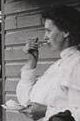 One of the oldest images of people eating ice cream is this photograph from the Nebraska State Historical Society collection. Members of the Nelson family are gathered around a table in front of a house, enjoying ice cream with their cake.
While the image of the Nelson family is the only image of a family enjoying ice cream at home in Nebraska Memories, there are several images of commercial ice cream shops. This 1915 photograph shows the soda fountain at Herpolsheimer’s department store. Several employees in crisp white uniforms stand behind the counter,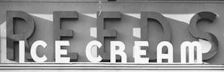 waiting to serve ice cream and sodas to customers. A later image shows the exterior of Reeds Ice Cream Shop in Omaha, advertising the day’s special of chocolate malted milk. Another image shows the City Café in David City. Although the teenagers in this photograph are enjoying sodas and not ice cream, you can see ice cream and syrup dispensers on the counter behind the young employee, who is wearing a bowl on his head and grinning for the camera.
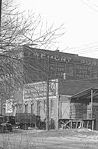 To explore the opposite end of the ice cream industry, take a look at this photograph of the Arctic Cream Company in Fremont. According to the advertising on the side of the building, this company produced butter and ice cream.
Visit Nebraska Memories to search for or browse through many more historical images digitized from photographs, negatives, postcards, maps, lantern slides, books and other materials.
Nebraska Memories is a cooperative project to digitize Nebraska-related historical and cultural heritage materials and make them available to researchers of all ages via the Internet. Nebraska Memories is brought to you by the Nebraska Library Commission. If your institution is interested in participating in Nebraska Memories, see http://nlc.nebraska.gov/nebraskamemories/participation.aspx for more information, or contact Beth Goble, Historical Services Librarian, or Devra Dragos, Technology & Access Services Director.

