Search the Blog
Categories
- Books & Reading
- Broadband Buzz
- Census
- Education & Training
- General
- Grants
- Information Resources
- Library Management
- Nebraska Center for the Book
- Nebraska Memories
- Now hiring @ your library
- Preservation
- Pretty Sweet Tech
- Programming
- Public Library Boards of Trustees
- Public Relations
- Talking Book & Braille Service (TBBS)
- Technology
- Uncategorized
- What's Up Doc / Govdocs
- Youth Services
Archives
Subscribe
Author Archives: Hollin Attendola
Friday Reads: Willful Creatures by Aimee Bender
You know those stories you (probably) read in your English 101 class? The ones that you still remember the experience of reading for the first time, decades later?
The Yellow Wallpaper; A Sound of Thunder; The Tell-Tale Heart; The Lottery?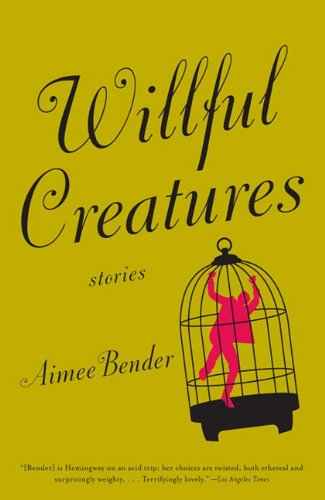
Willful Creatures by Aimee Bender is that experience, on repeat. The Los Angeles Times called the anthology, “Hemingway on an acid trip; her choices are twisted, both ethereal and surprisingly weighty … Terrifyingly lovely.”
“Twisted,” “ethereal,” and “weighty” are all superb descriptors for these stories. I do disagree with “Hemingway on an acid trip,” not because of the Hemingway comparison — which I find mostly apt; Bender uses long, winding sentences that don’t end up where one might expect — but because of the acid trip. That, to me, implies a lack of control, and Bender’s prose is anything but. It’s sharp and witty, well-crafted, well-paced, and intentional. Her stories operate on her own internal logic. Now, the reader may feel like they are on an acid trip: the zany, kaleidoscopic stories are both vivid and vague, like a particularly striking dream that leaves one discombobulated upon waking, but fades to half-remembered images and emotions ten minutes after.
I first read this book in my very first semester as a college freshman, over a decade ago. I was gobsmacked. Awestruck. I didn’t realize that people could write like that. I have not read the collection in its entirety since then, and so I was eager to find out what I thought now. There are only one or two stories that I find to be weaker — “Jinx” and “I Will Pick Out Your Ribs (from My Teeth)” — but the rest are solid, achieving a response that I only experience when reading a particularly fantastic poem.
My favorite stories from this collection are mostly in Part Three: “Dearth,” the tale of a woman who finds her cast-iron pot filled with potatoes, which return every day after she gets rid of them, and which slowly grow potato arms and legs and heads like children, increasing her desperation to rid herself of them (yes, she does eat one). “Job’s Jobs” is the story of God’s vendetta against a writer, and how the writer wins. “The Leading Man” is about a boy who is born with nine keys instead of fingers (his pinkie being the only exception), and who goes through his life seeking the matching locks. “Hymn,” the final story, is one of my all-time favorite short stories and is about a series of strange births. It ends with the lines: “my genes, my love, are rubber bands and rope; build yourself a structure you can live inside. Amen.” and it makes me cry every time. In fact, as I re-read this collection for the first time in years, I was struck by how many of the stories’ final lines were an emotional gut-punch. It’s like coming out from under hypnosis and then being informed that your dog was just hit by a car.
These stories must be approached with an open-mind. You cannot resist their strangeness, even when it disgusts you, otherwise you will miss something. There may be the instinct to retreat, to write the surreal tales off as nonsense (or an acid trip), but that, in my opinion, trivializes what Bender might be trying to do. I use the word “might,” because I still don’t understand some of them, even the ones that have stuck fast in my mind (“End of the Line,” the story about a very tiny man who is abducted and abused by a regular-sized man). But I think Bender is saying something about the inanity of life while simultaneously wrestling with — or arguing for? — the meaning of life. There’s an undercurrent of grief running through every story — I can see the shape of that, more clearly, now that I am older (wiser? sadder.).
If you like Willful Creatures, you will probably enjoy Bender’s full-length novel, The Particular Sadness of Lemon Cake. Somehow, Bender is able to maintain what she does in a 7-20 page short story through almost 300 pages. She has the range, darling.
Bender, Aimee. Willful Creatures: Stories. Anchor Books, 2005.
Friday Reads: Poor Deer by Claire Oshetsky

Perhaps what is most important is not the truth of our lives, but the stories we tell.
Or, as Poor Deer might argue, that’s a pretty saying that liars might repeat in an attempt to absolve themselves of guilt; nothing is more important than the truth.
Poor Deer is a quick-read of a novel. It is the confession and story of Margaret Murphy, who experienced an unthinkable tragedy when she was four years old. It is a strange literary punch of a novel, pirouetting on the incredible mutability and haze of a young child’s memory.
I won’t spoil the central event of Poor Deer; what really happened the day of the schoolyard flood in that small mill-town is not definitively admitted until the final pages of the novel. But it is a tragedy regardless of what happened, and the confusing swirl of emotions and accusations, memory and blame, sweeps poor little Margaret away and drowns her life in guilt.
There is a fascinatingly light-touch to the story; Oshetsky relies on an older Margaret’s narration of the story – flipping back between third and first person perspective — and in doing so avoids the common, belief-breaking pitfall of “a child would not think or speak like that.” The language and tone of the novel itself is childlike and ephemeral, straightforward and naïve, poetic and blunt, and it softens the blow of what is a very depressing story. Don’t get me wrong: it still is a depressing story, in which awful things happen. It is depressing in the way that classic fairytales are depressing, and I think that was Oshetsky’s intent. But it is not entirely depressing, nor is it unrealistic or cruel. Oshetsky does not batter Margaret beyond the possibility of recovery, or beyond redemption.
Margaret, who is now a young woman on the eve of another tragedy, is an unreliable narrator kept in check by the titular “Poor Deer” — an apparition who has been following Margaret since her childhood, who will not be dismissed until Margaret faces the truth. There are delightful and heartbreaking passages in which Poor Deer commands, “Again, again,” and Margaret starts again and tells her story honestly. “Is she real?” Margaret asks as she writes her confession under the weepy, vengeful gaze of the deer. “Does is matter? She is part of who I am.”
Oshetsky, Claire. Poor Deer: A Novel. Ecco, an Imprint of HarperCollinsPublishers, 2024.
Friday Reads & #BookFaceFriday: The Fabric of Civilization by Virginia Postrel
The most profound technologies are those that disappear. They weave themselves into the fabric of everyday life until they are indistinguishable from it.
Mark Weiser
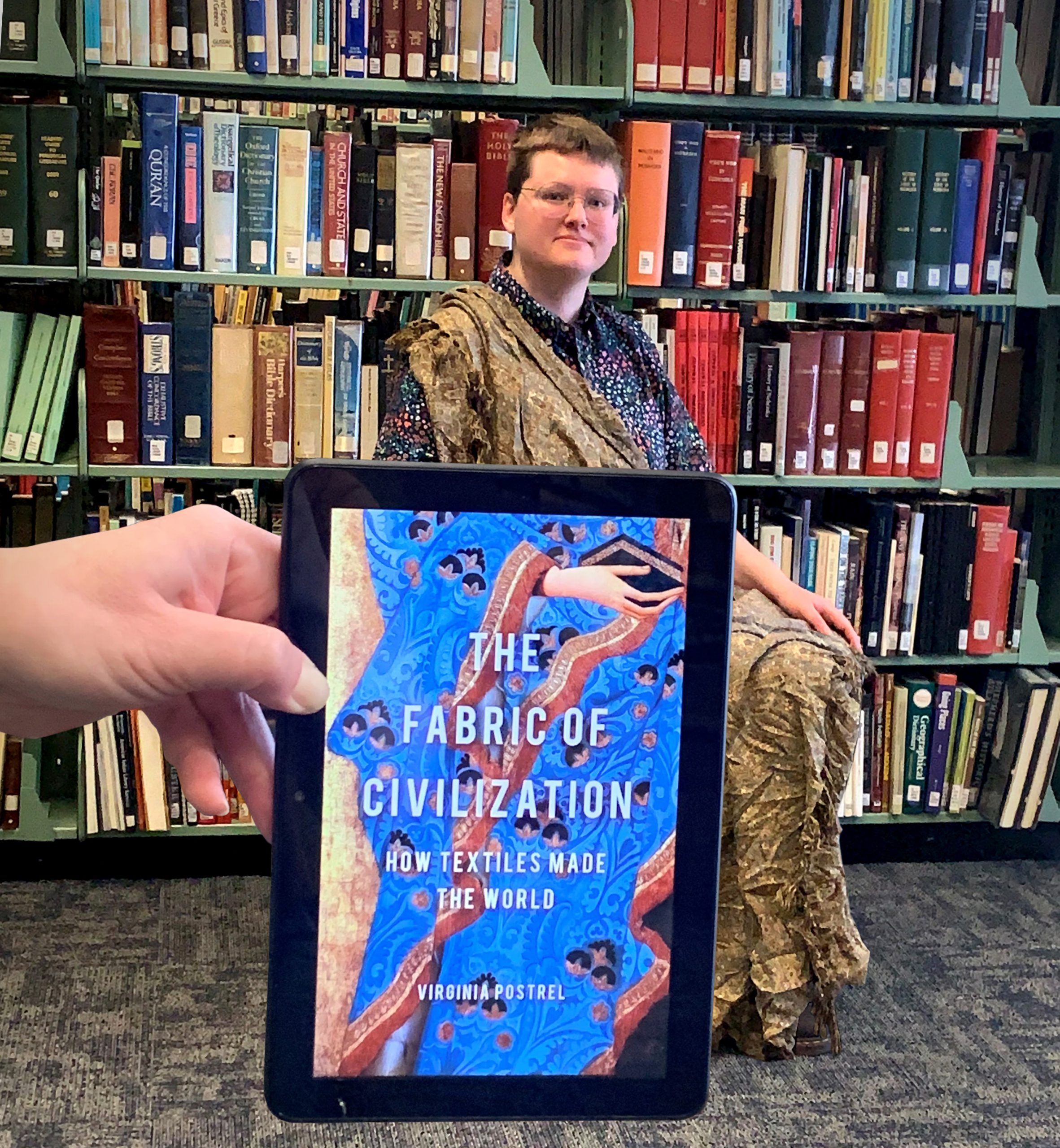
Virginia Postrel’s The Fabric of Civilization begins with the dawn of human history, with the first fibers twisted into string, and ends with modern innovators creating new fibers and types of fabrics. The book is sectioned into seven chapters, each covering a certain step in the fiber-to-textile life cycle: Fiber, Thread, Cloth, Dye, Traders, Consumers, and Innovators. Postrel’s core thesis: fabric was among our first technologies, and it was also our most crucial and defining technology — and it still is. “We hairless apes co-evolved with our cloth,” Postrel writes. “From the moment we’re wrapped in a blanket at birth, we are surrounded by textiles.”
This book was absolutely fascinating. As a knitter, crocheter, and now a beginning spinner, part of my awe for the fiber crafts comes from their long-stretching history: from me, to my grandmother, to endless generations past. The way I spin yarn from wool, sitting on my couch in front of the TV in 2024, uses the same motions that would be familiar to someone in ancient history. Fibers spun into thread were necessary for the cloth needed for sails, clothing, blankets, political functions, military uniforms, and religious/cultural rituals. My burgeoning love of spinning is likely why Chapter 2: Thread was my favorite. Postrel’s breakdown of how long it would take spinners and their spindles from different eras to produce the thread that was so crucial for exploration, competition, commerce, and general livelihood was incredibly thorough. Take a moment to think about all the fabric around you right now. That fabric is composed of woven threads or knitted yarns. Today’s modern factories use heavy machinery to spin fibers into miles and miles of that thread for jeans, cotton shirts, and wool coats. For much of history, however, that process needed to be done entirely by hand. Much of the rest of the world’s economy could not work until the spinners did, and the quest to expedite the process drove inventions and innovations that had far-reaching effects on industries beyond that of textiles.
At times, Postrel’s overview and analysis bottlenecks into myopia, and the occasional – but thankfully brief – insertions of her own personal experiences with the textile process were jarring. Postrel occasionally falls into a columnist’s cadence, sacrificing the distance of academic de rigueur for a more conversational tone. Another reader might appreciate the first-person connections and exposé-esque sections – a la How It’s Made – and I can certainly understand the reasoning behind her choice, but I did not find that these added much to the book.
Her myopia, however, is less forgivable. Postrel would have crafted a more solid body of work had she matched the title with the true scope of her endeavor, and called the book The Fabric of Western Civilization. Industrial Revolution-era Europe and New England are centered far more prominently than I would have preferred. Postrel touches briefly on the interaction between the South’s cotton industry and England’s mills — even after the latter abolished slavery — but doesn’t spend as long on that connection, even though I feel it would have bolstered her argument about global commerce and economy. This was an especially disappointing flaw, especially given Postrel’s own definitions of “civilization,” including the fact that it is a cumulative process not bound to one region or culture; in fact, as Postrel does mention, exchange (willing and unwilling) is what drove the evolution of textiles and humanity both.
Postrel also falls into the trap of rebuttal for the sake of novel arguments, which end up bordering on dismissal of broader historical truths: particularly and most egregiously in her argument about cotton in the Pre-Civil War South, singling out Edward E. Baptist’s The Half Has Never Been Told: Slavery and the Making of American Capitalism (2013) and his statement that increased cotton production was caused by ever-intensifying brutality inflicted on enslaved people. Postrel counters that the production increase can be simply explained, instead, by advancements in both cotton stock and processing technologies. However, there is no reason why both cannot be true. The same root issue is also at play when she disregards the low-wages of the pre-industrial (and typically female) spinners as solely a business decision, devoid of the influence of gender and class politics. History is not a field with single-causes and single-effects.
Part of the appeal of non-fiction to me, however, is actively engaging with the arguments that the author presents. A sense of wonder is important, but I also want to think about the topic and build my own perspective. And so, overall, I enjoyed the book. I listened to the audiobook read by Caroline Cole, but I do plan to check out the print copy from my local library, in order to explore Postrel’s footnotes and bibliography for further reading and learning opportunities.
You can find “The Fabric of Civilization: How Textiles Made the World” by Virginia Postrel is available for download on BARD, the Braille and Audio Reading Download service. BARD is a service offered by the Nebraska Library Commission Talking Book and Braille Service and the National Library Service for the Blind and Print Disabled at the Library of Congress.
Love this #BookFace & reading? We suggest checking out all the titles available in our Book Club collection, permanent collection, and Nebraska OverDrive Libraries. Check out our past #BookFaceFriday photos on the Nebraska Library Commission’s Facebook page!
Postrel, Virginia. The Fabric of Civilization: How Textiles Made the World. Basic Books/OrangeSky Audio, 2021.
Friday Reads: Goldenrod by Maggie Smith
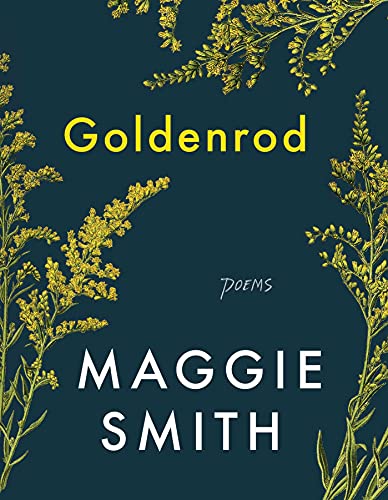
I am going to come out and say it: when our license plates were the meadowlark and the goldenrod, I loved them. I thought they were beautiful. Goldenrod may look like the allergy sufferer’s nemesis, ragweed, but is it innocent, blameless, unfairly maligned! A lovely, important part of our ecosystem, and a worthy state flower.
That was not why I chose to read Maggie Smith’s 2021 poetry collection, Goldenrod, but it was a point in her favor. One of my favorite poems is actually Smith’s “Good Bones.” My copy of Goldenrod was gifted to me from a friend and former mentor; it is possible that I have shared “Good Bones” to my social media so often that I have become associated with Maggie Smith (high praise).
Goldenrod is composed of three sections of poetry, the themes of which are: birth, death, nature, motherhood, and life. There’s a sprinkling of an homage to Mary Oliver — just a hint, just a flavor; to me, no one can hold a candle to Mary. But Mary was just one part of the conversation, and there must be other voices now.
A couple of poems that stood out after my reading were: “For My Next Trick” and “Wild.”
“For My Next Trick” centers around a conversation between the narrator — a mother — and her daughter, who asks
“Where was I …
before I was in your body?
–What was I?”
It’s a conversation about where we (might) come from, and what (might) happen after we die, and the connection between death and life, and what (might) go on after us. The (maybe) answer comes in the last stanzas of the poem-conversation:
I tell her the stars
are the exception–
burned out but still lit.
No, not ghosts,not exactly. Nothing
to be scared of.
That final sentence “Nothing to be scared of” is so poignant in its simplicity, the tone perfectly set for talking to a child — and as a result, it is comforting regardless of age.
“Wild” really called to mind the Mary Oliver homage for me; there is so much to loving the world, and struggling to love it, and just existing despite the brutality of man and nature. “Wild” also feels like a worthy companion to “Good Bones.”
I’ve talked so much about loving the world
without any idea how to do it.
…
The world I’m trying to love
is all teeth and need, all gray mange
All poetry is conversation, and I hear these lines as speaking towards “At the River Clarion“, specifically one of my favorite lines, which itself spins back to Tennyson, and nature, red in tooth and claw (In Memoriam A. H. H.):
If God exists he isn’t just butter and good luck.
He’s also the tick that killed my wonderful dog Luke.
Said the river: imagine everything you can imagine, then keep on going.
Overall, a delightful and meditative collection of poetry that can be read in an afternoon — but probably should be read slowly, and savored like a good cup of tea.
Maggie Smith is the author of several other poetry collections, as well as her 2023 memoir, You Could Make this Place Beautiful.
Smith, Maggie. Goldenrod: Poems. One Signal Publishers/Atria, 2021.
Friday Reads: How to be a Good Creature: A Memoir in Thirteen Animals by Sy Montgomery
“‘Tis a fearful thing, to love what death can touch” (Rabbi Chaim Stern, attributed).
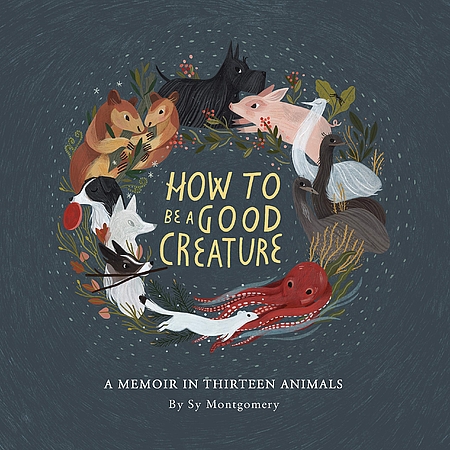
I needed a good short read this summer. Sy Montgomery’s How to be a Good Creature — weighing in at just over 200 pages (roughly 3 hours in audio) — fit the bill. I had flagged it for my To Be Read list years ago, when the title and cover first struck me. The faint nod to Mary Oliver’s famous poem, “Wild Geese” likely helped How to be a Good Creature stick in my mind.
Montgomery titles each of her book’s chapters after an animal – or two, or three – who made a significant impact on her life as a writer, as a naturalist, and as a human being. I especially enjoyed her focus on the uncommon, harder-to-love animals: the bird-eating spider, the tarantula, the octopus. I myself am committed to the lifelong learning experience of being my own good creature, which has manifested as of late in the hair-raising rescue of insects who have found their ways into my spaces through no fault of their own.
At the heart of Montgomery’s book are the border collies with whom she has shared her life: Tess, Sally, and Thurber. Each border collie appeared exactly when they were needed — an experience I share with many of the dogs who have accompanied my own life. Beside them, a pig named Christopher Hogwood. Rescued as a tiny piglet, Chris grew into a 700lb gentle giant.
As I write this, processing the book in its entire, I realize that what irritated me the most about How to be a Good Creature was that far too often the book swung between sneak-preview and overt advertisement for Montgomery’s other adult nonfiction books: The Soul of an Octopus (2015) and The Good Good Pig: The Extraordinary Life of Christopher Hogwood (2006). I got what I could ask for from a short, quick read, but if I had to pick up another one of her books for my introduction to Montgomery, I think I would have picked one of these two instead.
Montgomery loves her animals, despite most of them being long gone from this earth. That’s fine — in fact, that’s great, because (to quote an excellent movie) “Death cannot stop true love.” We humans are so much longer-lived than the animals who join us on our journeys; to be an animal lover is to put a layaway on grief. However, the significant amount of woo-woo (an informal term for what I felt was a mystical and anthropomorphic perspective taken too far) and Montgomery’s wild mood-swings (which would have been better balanced if the book had been single-minded and significantly longer) detracted from my overall enjoyment of an otherwise poignant book.
While I do not believe that Montgomery lived up to her thesis, I did find value in my read. In one of her shortest chapters, “The Christmas Weasel,” Montgomery recounts the story of the time an ermine (a sleek weasel-like animal), who killed one of her beloved hens at Christmastime. What it sorely lacks in stature and size, the ermine makes up for in ferocity and confidence. When Montgomery takes the body of her hen, the little weasel charges at her, enraged at the loss of a good and necessary meal. There’s a wealth of commentary here: the blameless act of an animal doing what an animal must do, humanity’s constant and futile battle to remain separate from nature, and the inseparable nature of life and death.
Sy Montgomery narrates the audiobook, and in my research of her biography, I learned that she was a radio commentator. Her narration is crisp and even, (mostly) properly emotive, and overall well-done. Her performance played out at just the right tempo for an afternoon of sewing.
Sy Montgomery, and Rebecca Green. How to Be a Good Creature : A Memoir in Thirteen Animals. Boston, Houghton Mifflin Harcourt, 2018.
Friday Reads: How Much of These Hills is Gold by C Pam Zhang
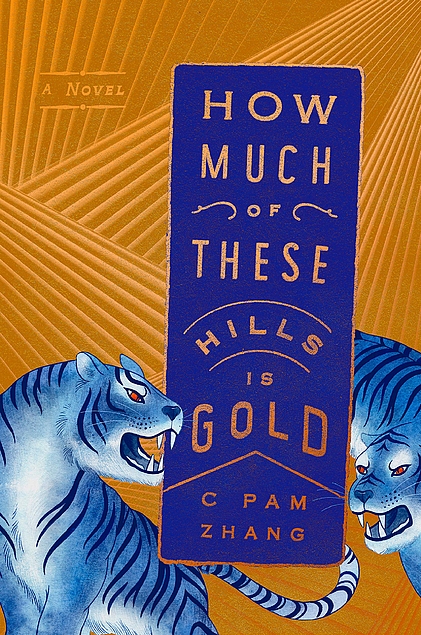
Gold. Coal. Fire. Water.
C Pam Zhang’s debut, highly acclaimed novel is set in the years following the ’49 Gold Rush. We are introduced to our small cast of characters — a Chinese family — as they choke on grief and coal dust: Ma is gone. Ba is gone, too; gone with her even before he dies in the coal-town shack, starved from life by alcohol and rage. Left behind is his twelve year old daughter, Lucy — our protagonist — and eleven year old Sam.
It is difficult to explain how wonderful this book is without spoiling its intricacies. Through lyrical prose that vacillates between golden and gritty, each carefully chosen word rich-full of marrow, sharp and hard as bones, we follow Lucy and Sam as they try to find footing in a world that does not want them. They are each their parents’ children: Lucy, so much like their mother, even with their father’s eyes, and Sam, so much like their father, even with their mother’s beauty. And, like their parents, they love each other. They hate each other, too. Lucy and Sam were born to this land, but they are treated as though they are strangers and unwelcome guests. The tension of being considered outsider, pushed to the margins of the already liminal territory of the West, is a reverberation that hums behind every page.
I started with the audiobook, first, and it was a challenge: Zhang’s writing is quick, succinct, dreamlike. Her brilliant prose flows through the story like a stream, varying from trickles to floods, and the shifts from scene to scene were dizzying. I borrowed the eBook from the public library and followed along with the narration. After I had read a few chapters in text, I got a sense of the book’s construction and was able to continue solely in audio. Catherine Ho’s voice is dynamic, fluid, haunting; she seems to savor every word, turns them over in her mouth, transforms them. I wasn’t expecting the narrator swap in the middle, but Joel de la Fuente was equally superb: his voice made the soliloquy of history shine, as his character turns the story on its head.
How Much of These Hills is Gold reads like a tale illustrated best by a campfire’s light. An oral history of winking secrets: what is inherited, what is not, what is stolen, what is owed, and what home means. It reads like the best kind of fairy-tale: grim, memorable, familiar, foreign, full of violence and injustice but never entirely devoid of hope.
Zhang, C. P. (2020). How much of these hills is gold. Riverhead Books.
Friday Reads: Everyone in this Room Will Someday be Dead by Emily Austin
If I stand near the edge of anything, I think about stepping off.
(165)

It is called gastrointestinal stasis, and it is a common cause of death amongst rabbits.
To the untrained and inexperienced eye — for example, to children, who take on these complex creatures as pets, with no money of their own to provide the best quality of life — the rabbit, as it is phrased in the classic book Watership Down, just stops running. Suddenly. Frozen, with eyes open.
Her name was Pumpkin, and she was a very good rabbit. I picked her because she was soft and reddish-brown, and because her lop-ears had yet to lop. She was smart and gentle and friendly, and I loved her. She stopped running and was dead before I woke. To me, eleven years old and weeping, there didn’t seem to be a cause.
Pets are, if we are lucky, our first introduction to death. They are never our last.
Gilda — a nearly-thirty, atheist lesbian — has death anxiety. It probably started with the sudden death of her childhood pet rabbit, Flop. It doesn’t help that she has major depression, panic attacks, and suicidal thoughts. Or that her parents are ignoring her brother’s spiraling alcoholism, or that she has recently been fired. It also doesn’t help that, in an effort to find affordable mental health counseling, she finds herself accidentally interviewed and hired for a job as a secretary — in a Catholic church. It also doesn’t help that reason for the job opening was because Grace, a sweet and well-loved woman well into her 80s, died. Or that dear sweet Grace may have been murdered. Or that Gilda, in a comedy of errors, assumes Grace’s identity through emails to Grace’s old friend Rosemary — who doesn’t know that Grace is dead.
Everyone in this Room will Someday be Dead is a poignant study of what it means to be a functioning adult, the ennui of the end of young adulthood, and the wrenching agony of growth. Austin’s writing is sharp, concise, and emotional; although at times, Gilda as a character and narrator frustrated me. It is sometimes difficult to be at a further stage of healing and growth than a character, maybe because I cannot offer them any advice or reassurance; or, maybe, because Gilda’s story hits a little too close to home. At times, I was reminded of Patricia Lockwood’s No One is Talking About This. Both books offer the same blunt and cathartic exploration of mental health, death, and the grief that comes from both (the grief from loss of the self, of relationships, of experiences).
Going into the book, I sort of expected a dark comedy or a mystery story (I have been very interested in mysteries lately). Everyone in this Room was neither. True, there were bright and shining moments of comedy that pierced the dark morbidity of Gilda’s story, such as when, food rotten in her fridge at home, she steals a bag of crackers from the church — and finds out she has stolen and eaten a bag of communion wafers (49-50). The main plot in the book is ripe for comedy, and Austin plays with that without trivializing or overshadowing the novel’s very serious tone and subject matter. These (brief) moments of levity stand to make the unflinching look at all of our mortality that much more impactful. There is an old adage, “make them laugh before you make them cry” — Austin succeeds in this, whole-heartedly and unabashed. I cried more than I laughed, yes, but I did laugh. It was a catharsis.
I think that I will leave you with Mary Oliver’s poem, “When Death Comes.” May we all accept the inevitable with grace, and grow kinder for it.
Austin, Emily R. Everyone in This Room Will Someday Be Dead. Atria Books, 2021.
Friday Reads: While My Pretty One Knits by Anne Canadeo
There is nothing like a good mystery.
While My Pretty One Knits is not exactly what I would call a good mystery. The murderer’s identity was obvious before the close of the first chapter. The village of Plum Harbor unequivocally fails to process – or even react much to — the brutal murder of one of their fellow villagers (it was brutal! And, as the book itself repeatedly reminds us, it was bloody!). There are enough knitting inaccuracies that unravel long enough to purl a swoncho. The knitting group doesn’t so much solve a murder so much as they stumble around talking about the murder, and incidentally and coincidentally facilitate the solving of the crime. And, as my fiancée put it with nothing but fondness, our dear anxious protagonist Lucy is “a bit touched in the head.”
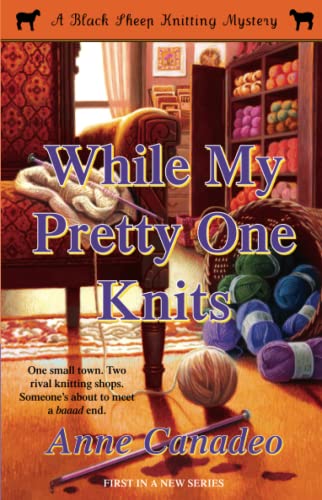
Yet I finished the book feeling…well, cozy.
There were no high stakes (ignoring the fact that, had the murder gone unsolved, a cold-blooded killer would have gotten off scot-free). There was a dog (who did more work to solve the case than her human caretaker). There was knitting and humor. It was the cross between Hallmark and Lifetime that I’ve been seeking, even if the needles pointed more towards Hallmark. And it was, simply, fun.
Our core cast of characters include Maggie, the shop owner; Lucy, the newly divorced graphic designer; Dana, the psychologist; Suzanne, the real estate agent and mother; and Phoebe, the college student. There are many more characters, which helps the village feel populated, although in audiobook format it was difficult to keep everyone straight, and I eventually stopped trying. Familiarity will hopefully come with time.
I don’t hold out much hope that, as I continue the series, the ridiculously high statistics for murder per capita in Plum Harbor will be cause for concern. Luckily, the group has Suzanne. When the population dips down too low to support the village economy, they’ll have a head start on packing up and moving out.
I am, however, optimistic that the knitters of The Black Sheep will learn and change and grow. That’s what I’m interested in. And, I realize, as I frog back my snobbery; that’s what all cozy mystery aficionados are interested in. That’s what the writer is interested in. It was never about the mystery — it was about the characters.
And isn’t that warmer than a wool sweater?
Canadeo, Anne. While My Pretty One Knits. Pocket Books, 2009.
Friday Reads: Upstream by Mary Oliver
In this universe we are given two gifts: the ability to love, and the ability to ask questions.
“The Bright Eyes of Eleonora: Poe’s Dream of Recapturing the Impossible,” Upstream, 91.
Mary Oliver is a dear friend of mine.

I do not mean, of course, that I have met her — or that I shall ever meet her (what a strange journey that should be!). But her words — her poems, her essays — sink deep into the blood-marrow of my bones, and I recognize on some thrum of instinct, kin. This is also not to say that ours is a kinship of talent; I shall not match Mary in writing (I think that she would say I would be a very poor writer, to only follow the paths she wandered).
Upstream, published in 2016, three years before her death, is a collection of essays, the central conceit of all being nature and literature. I do not mean nature and literature in the way one, who might need to restock their pantry, might list bread, and then list cheese. It is bread and cheese, meant to be together, and one without the other would render the entire trip moot, for naught. It is the same way that Mary’s essays are about nature and literature. You simply cannot, she says, have one without the other.
And what is the point of all this? — if one dares to ask a question. I set out to say that Upstream is a wonderful book on which to meditate — her collected work of poetry is like a Bible to me — but in re-reading the essay “Some Thoughts on Whitman,” I was struck by Mary’s line that “[Whitman’s methods were] to move the reader toward response rather than reflection” (94). Which is, of course, to say that Mary — a devotee of Whitman; I can think of no better word — has an intent to move us, the reader, to response! The hum through these pages is not to simply read this book, but to do so in public, out of doors, whooping in jubilation!
In Upstream, the reader journeys through Five Parts of the collection; the two opening sections are crafted around nature, as are the two closing sections. Part Three seems to be the odd duckling out — it is about literature, and if one does not find amusement in literary criticism, this Part may cause the reader to drag their heels. (I myself skimmed through the essay on Poe.) But, turning that eye back on Mary, one can view the construction of the book in its entire around Part Three; it is why the conceit is nature and literature. Upstream would have made a very fine collection if it were solely about nature, just as one can eat bread without a companion; likewise, Mary’s intellect, wit, and spirit of play in her literary criticisms would stand very well on its own, as one can enjoy cheese without any vehicle. Putting the two together is fantastic; each whole part amplifies the whole, exquisitely, and entirely filling.
In all of its total, Upstream is a short book and can take only an afternoon to read. It is inspiring, in the way that means that it will put the breath in you. Whether the energy of that breath is to write, to create, to dance — all very well. But more so than that I think that, after you close the final page, you would find yourself taking your hat off of its hook and setting out the door for a very long walk.
“Come with me into the field of sunflowers is a better line than anything you will find here,” Mary tells me at the beginning of the book from where she is, already waiting at the ending. “The sunflowers themselves far more wonderful than any words about them.”
Oliver, Mary. Upstream: Selected Essays. Penguin Books, 2019.
Friday Reads: No One is Talking About This by Patricia Lockwood
They kept raising their hands excitedly to high-five, for they had discovered something even better than being soulmates: that they were exactly, and happily, and hopelessly, the same amount of online (118).
To be “Online” is to immediately call your girlfriend when researching the author of the book you read and find out, to your shrieking delight, that the author also the author of The Miette Tweet. “No way!” Thought I. “She wrote The Miette Tweet!?” shrieked my girlfriend. We knew her! We knew her before she wrote this book — and of course she wrote this book! And if that experience of discovery (and the parasocial feelings it triggered) wasn’t in some sort of spirit of No One is Talking About This, I’m not sure what else to say.
What I wanted to read was a tragedy, and a tragedy from the present moment. I have been trying to work my way through The Iliad (trans. Caroline Alexander) and its gravity was too much; Memorial: A Version of Homer’s Iliad by Alice Oswald was better, but it was still too distant from what I felt now. When the reviews for No One is Talking About This told me that Part One was hilarious (or incomprehensible nonsense, depending on how “Online” one was), but that Part Two would cleave your heart in half and leave you unseamed, I dove right in.
No One is Talking About This is a stream-of-consciousness series of “portal entries” (read: Tweets) that follow an unnamed woman who becomes famous for the viral hit of “Can a dog be twins?” Elevated into the comedic spotlight and now an Influencer, she globe-trots to offer her Neodadistic philosophies. All the while, a sense of emptiness chases her. There’s a frantic pulse behind the words she throws out into the portal with her fellow portal dwellers — the familiar questions of “Are we just going to keep doing this till we die? … Are we in hell?” (12) There’s a feeling, which perhaps anyone who has been online too long has encountered, of trying to get one’s hands around the nonsense of everything and shake it so hard that something falls out, so that we can grab that thing and shake it and demand, “what does it mean? what does it all mean?”
Then, a text from her mother: “Something has gone wrong. How fast can you get here?” (119) And the whole of reality — the one that you cannot unplug from — comes crashing in, inescapable.
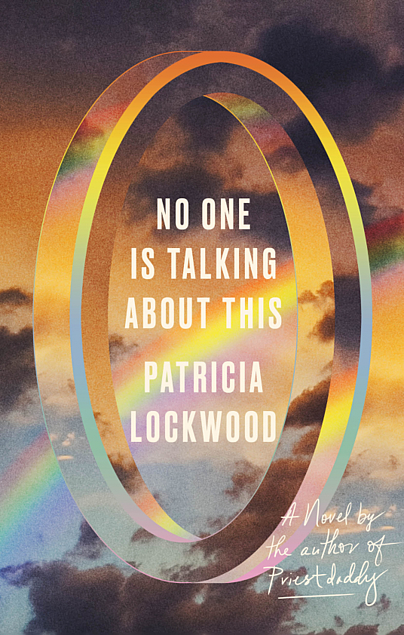
In the end, I wrestled slightly with my categorization of this book as a tragedy. But I think it holds. Here is a character, and her family, and what they go through is suffering (although it is not all suffering). But it does not end “happily,” in the way that there will be a miracle that stops the inevitable, that turns the ending; there is no deus ex machina. What I wanted from tragedy — what I think we all seek, from tragedy; why we watch Hamlet and Macbeth fret their petty hours on the stage, why we watch the war-gates of Troy open in celebration — is catharsis. To know how it will all end, to face it, to weep, and then to rise up again, wiser. Lighter. I wept through the ending of the book but I was not left hopeless and adrift.
If you are not chronically Online, you might struggle with Part One, but Lockwood’s prose and profundity throughout might guide you around the seeming nonsense (I myself have never been a dedicated Twitter user; I came of age on a different blue hellsite). If you don’t think No One is Talking About This would be your jam, at least please read about Lockwood’s cat, Miette, who is Twitter famous, and speaks in a British accent.
No One is Talking About This was shortlisted for both the 2021 Booker Prize and the 2021 Women’s Prize for Fiction. It is Lockwood’s debut novel.
Lockwood, Patricia. No One Is Talking about This. Riverhead Books, 2021.
Friday Reads: The Road by Cormac McCarthy
“He thought the month was October but he wasnt sure. He hadnt kept a calendar for years …
He lowered the glasses and pulled down the cotton mask from his face.”
This is how Cormac McCarthy’s The Road begins.
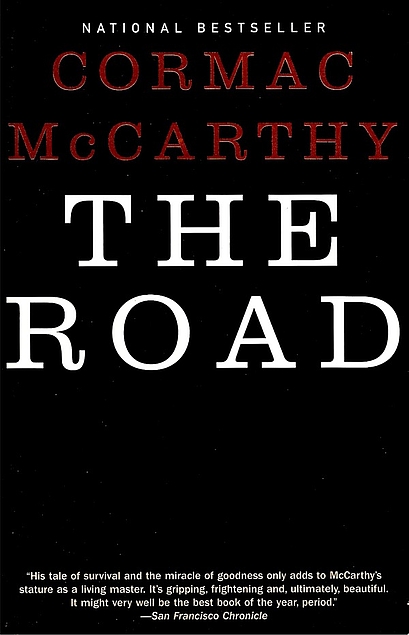
It sounds familiar. It sounds relevant — timely; I was afraid, almost, that it would be too timely.
I’d read The Road before, years ago, and it easily became a favorite. Something about McCarthy’s prose is more akin to poetry, and that teetering, razor-edge brilliance of darkness not entirely lost to despair. This is a book whose memory of reading has haunted me through our own ever seeming dystopia; the world darkening through the corners like a vignette. And something beckoned me towards the book again; a glimmer of hope, survival.
This time, I chose the audiobook. Because this time, I was thinking about stories, and what will come next, and what came before: how stories were told without paper, how simple it seems to carry something that weighs nothing more than the air in your lungs. How stories might ask to be told again, in the future (a clock, time, is a great circle).
I’m a reluctant convert to audiobooks — my attention “span” is more of a blip these days, but I ended up listening while laying in bed, right before sleep. I’m sure this was partially responsible for some stressful dreams, but to be honest, they weren’t really any worse than normal.
The other trouble I have with audiobooks — the primary reason for my hesitation — is that I am so very picky about narrators. When I first played the recording of The Road, courtesy of my public library’s hoopla service, I almost backed out.
At first, hearing McCarthy’s words read instead of reading them was a jolt. McCarthy’s style is sparse — he eschews punctuation, dialogue tags, constructs sentences in short, sharp bursts. To hear it spoken out was so different than seeing it on the page; and yet, as I adjusted, listening ended up grounding the prose much more familiar terms. And, to be honest, it became enjoyable. When less engaged from the work of literature, I picked up on new dynamics of the story, new emotions; the narrator Tom Stechschulte, delineated the characters with excellent voices, and added a layer of closeness I don’t think I’d had to the story before. I’d originally enjoyed The Road because the language was gorgeous, and I like McCarthy’s style. I respected the human element, but I hadn’t connected to it. Having an actual person read the story — bring it to life, add dimension, did that for me in a way that hearing the story in the theater of my own mind wasn’t quite able to do. Near the midway point in the book, there’s a scene between the man and his wife — a terrible argument, about the horrors and reality of their future — that I felt was so well acted, and I was caught up in it, breathless.
The center of The Road is the man, and the boy — his son, his only son, and his legacy, and his only reason for living — unnamed and surviving the last gasps of a world ended on the road, trying to make it south, to the coast where the winter might be survived. On the surface, there’s really no reason to survive. Nothing is going to get better; in fact, in a world where cannibalism has become a fore-running dietary option, humanity made macabre ouroboros, it’s safe to say things are only going to get worse. Yet, call it foolish, call it stubbornness, call it humanity — the man and the boy keep going. Still they keep going, down the road.
I’ve always read that as the definition of hope, and now I’ve heard it, too.
McCarthy, Cormac. The Road. Narrated by Tom Stechschulte, Recorded Books, Inc., 2006. Audiobook.
Friday Reads: Bright Dead Things by Ada Limón
“I want to try to be terrific.
During the Impossible age of everyone (23)
Even for an hour.”
Ada Limón is an American poet who, along with Richard Siken, Natalie Diaz, and Mary Oliver, is one of my favorite poets. Her poem, “The Leash” – which is not included in this collection – is a poem I reach for like the hand of a trusted friend, after stumbling on the road. I know that it will be there to pull me back onto my feet.
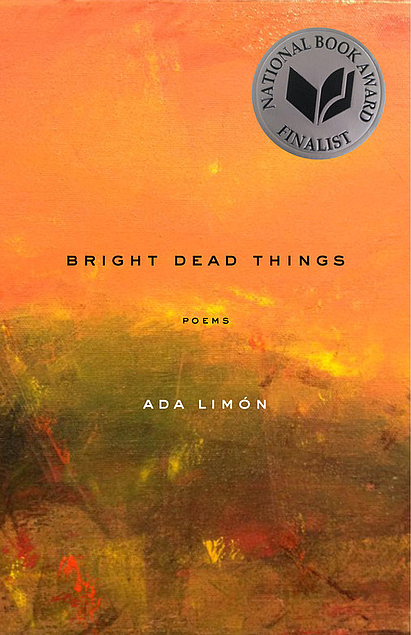
Bright Dead Things, published in 2015, was a National Book Award finalist. It is Limón’s fourth collection of poetry. I could stare at its cover all day.
Poetry is a heavy, fluid beast to review and recommend. You cannot trap it, pin it down. Every poem is a kaleidoscope, shifted in image from the time of my witnessing to the moment that I hand it to you. How can I show you a poem and have you see the same poem?
And yet, Limón’s collection in Bright Dead Things is about the universal, the human, the everyday: nature, grief. The body, the entropy of the body, life, and the passage of time.
In “State Bird,” Limón writes about her move to Kentucky from New York in a way that is so personal that tears sprang to my eyes, because it was exactly how I felt about remaining in Nebraska, despite my original, younger plans to leave for some distant, fresher place. “Confession: I did not want / to live here, / among the goldenrod, / wild onions, / or the dropseed” (58). Peace is made with it; on her part, and on mine. “Sometimes,” Limón writes in a later poem, “Oh Please, Let It Be Lightning” (174), “you have to / look around at the life you’ve made and / sort of nod at it, / like someone moving their / head up and down / to a tune they like.” There’s a repetition, to use a grief analogy — this collection is, I think, at its heart, about grief — of coming through the stages to acceptance and back again, like the way the wind changes direction.
There’s a line that struck me, from “Miracle Fish”: “I swear I will play on this blessed earth until I die” (64). Her use of the word play is fantastic, poignant. Not work, not grin and bear it, not survive: I will play. Especially since this collection is saturated (as life is) with grief. With lost family, lost homes, lost friends – lost, sharp as I read this in the ongoing roils of a pandemic, time. Limón takes that grief and rather than shear it from life (as we are wont to do, or want to do) — she says, this is a part of life. This is how it happens. This is a part of what make us alive. Death, loss — it is not an antithesis, it is a harmony.
Overall, the image of the bright dead things has remained with me. I won’t spoil that poem’s title here, so that you can discover what they are for yourself. Maybe you can carry them with you as well, you, ebullient and reckless, you, living just because you can.
Limón Ada. Bright Dead Things. E-Book, Milkweed Editions, 2015.
Friday Reads: The Fire Never Goes Out: A Memoir in Pictures by Noelle Stevenson
“You’ll be okay. But you’ll lose some things” (35).
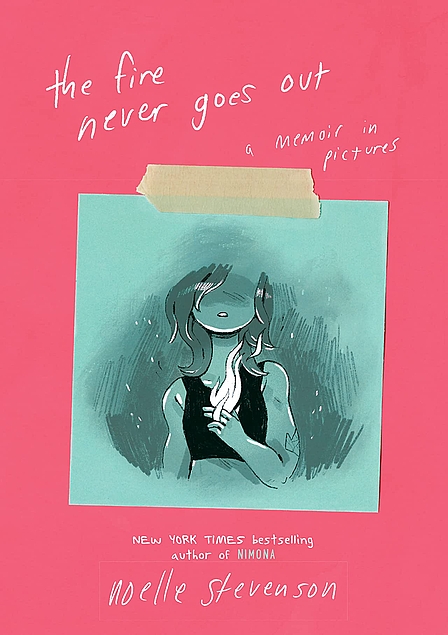
I believe it was early 2014, late into the last dregs of winter in my freshman year of college, when I got into webcomics. The serial format meant something to look forward to each week (in an era where Netflix “bingeing” was starting to take off), and there was a diverse buffet to choose from — not just in style, but in content. I’m not certain how I stumbled across Noelle Stevenson’s Nimona — then a webcomic, still running in series, now a New York Times bestseller and National Book Award Finalist — but I did, and it shaped me, and when I saw the published, physical copy in my college’s library my senior year I carefully lifted it down from the shelf, held it in my hands and, well, cried.
The Fire Never Goes Out: A Memoir In Pictures is Stevenson’s story, from 2011 (before Nimona) to 2019. Stevenson — who uses she/her pronouns in the book jacket; her Twitter bio currently states that she accepts any pronouns — compiles comics and reflections from each year, centered around the idea of an inner fire — something that drives her, plagues her, inspires her, and burns her out at the same time.
While the book almost felt, at times, more like a scrapbook than a memoir, Stevenson crafts a poignant, moving, and powerful journey that is both intimately personal and welcoming in its relatability. The scrapbook/memoir is semantics, perhaps, on my part; however, I think I would have liked more of Stevenson’s current-self writing summaries of their past years, partially because I adore their writing style and partially because I felt a little cheated of original content (the book does contain new material); however, I also understand why they chose to recycle past blog entries. Besides, when I was honest with myself, even though I dimly remembered following Stevenson somewhere on the interwebs back in the day, it’s not like I actually remembered their yearly summary posts.
In his highly recognizable art style, Stevenson reaches out to his younger self and says, Hey — things suck, but you’re stronger than you know. You make it. It’s the “things get better” speech I needed to hear — that I, too, wish I could go back and tell my younger self — without the everything gets better. Not everything does. Things still suck. The fire never goes out. Some holes never get filled. Some scars don’t fade all of the way. We keep going, and growing, anyway.
Overall, like most graphic novel-style books, this is a quick read. And it isn’t all the heavy-hitting solemnity of finding one’s way through young adulthood, mental illness, and burnout; there are also moments of levity and love and humor. Stevenson finds herself, falls in love, and shares her art with countless people. The memoir ends up being a balanced, realistic piece, filled with beautiful sketches and art.
If you liked Nimona, you’ll like this memoir. And if you haven’t yet read Nimona, pick both graphic novels up and enjoy two good afternoon reads as we enter brighter days.
Stevenson, Noelle. The Fire Never Goes Out: a Memoir in Pictures. Harper, an Imprint of HarperCollins Publishers, 2020.
Friday Reads: War of the Foxes by Richard Siken
“Trust me. I have things to say” (14).
Poetry is a difficult genre to review. Poetry is a personal subject: for each of our bodies, there is a poetry that corresponds, that resonates and echoes with us.
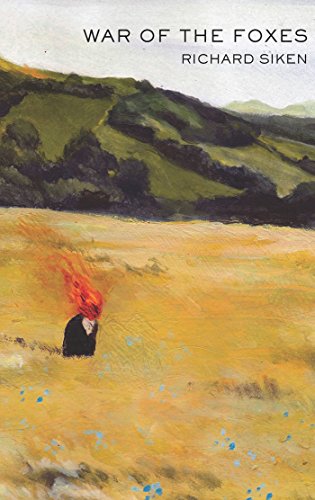
Richard Siken’s Crush is my favorite collection of poetry – and one of my favorite books. I went through a period in my life when I read it once a week (on Sundays). I’ve recorded myself reading poems from Crush and sent the recordings to romantic prospects (with varying degrees of success, but that says nothing of Siken).
War of the Foxes is not Crush. There is a different amplitude about it. It is less concussive than Crush; more a stiletto knife through rib-spaces than a gut-punch (I like my poetry like a back-alley-fight — I like to come away with marks, impacted). And yet, perhaps it is not fair, I think, to talk about Foxes in the shadow of Crush (though how to separate them? there is no yolk from the white. if you do read Siken, you should start with Crush; the climax and catharsis of grief and the understanding of how he frames poetry is, perhaps, clearer in the older anthology).
So let’s talk about War of the Foxes. We begin in an art gallery. And that is what Foxes is, at the end of it, I believe: an art gallery. This may seem inactive. This is especially so if you do not particularly enjoy art galleries, have not been to an art gallery in a long time, or do not realize that while you are looking at the art, the art is also looking back. “All painting is sent downstream, into the future” (26). There’s the impression that the artist remains the active participant, the repetition of the act of creation, even as the viewer is looking (or we are). But what is the art, and who is the artist, and who is the viewer – these are the questions behind the obvious, behind the poems; “We do not walk through a passive landscape. The paint dries eventually” (6). Using something to talk about something else: this is poetry. (This is a good story). This is an exhibit on history, on war, on love. On birds. Ghosts. Paintings. “What is a ghost? What is a painting? Yes and yes, / the same answers” (42). War of the Foxes invites us to look within each frame and to see what we can find — ourselves, and maybe each other. “What’s the difference between me and the world? / Compartmentalization” (40). Connection is the art of it.
When I selected this book to review and began my post, I didn’t know that I would wake up on December 4th to the news of a new poem by Richard Siken. This is wonderful news because, in the Spring of 2019, Siken suffered a stroke and underwent a long recovery, during which he wasn’t sure he would ever be able to write again. Today, he shared “Real Estate.” I am delighted to have him back again.
Siken, Richard. (2015). War of the Foxes. Copper Canyon Press.
Friday Reads: Upright Women Wanted by Sarah Gailey
ARE YOU A COWARD
tagline from the cover
OR ARE YOU A LIBRARIAN?
When it seems like absolutely everything is going awry, cracking open a work of dystopic fiction doesn’t sound like the wisest idea, but Gailey’s novella Upright Women Wanted is a timely message of hope, community, and resistance – and of Librarianship.
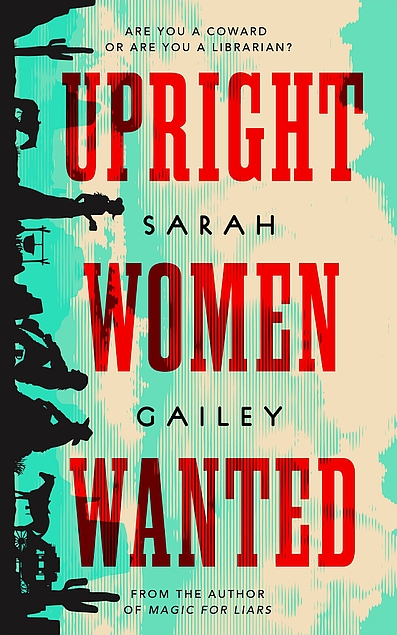
Yes, this book is about Librarians. Gunslinging, horseback-riding, revolutionary queer librarians. Upright Women Wanted is something of a Western, set in the near-future, and is pretty much everything I’ve ever wanted from a story.
When Esther flees from home after her (secret) girlfriend Beatriz’s execution at the hands of her father, she stows herself into the back of a Librarian wagon, determined to become a morally upright woman (as all Librarians, who are tasked in this dystopic, what Publisher’s Weekly called “neo-western,” America to distribute Approved Materials, are supposed to be).
What Esther is soon to discover is that nothing she was told about the world, about Librarians – and about herself – is true. As she makes her way across the Southwest in the company of the Librarians, she’s forced to reckon with the State of things (pun intended), and with who she is and who she can be and love.
I love a Western, and I love a diverse Western, especially, and most of all I love a diverse, science-fiction Western. Throw a band of roving librarians into the mix and I’m sold. One of the events in history that I am most fascinated by is the WPA Pack Horse Library Project, ever since I stumbled across That Book Woman by Heather Henson. The Pack Horse Library Project is such a unique time period, and it captures the imagination and inspiration. Librarians are connected to our communities in a unique way, and the way we strive to maintain those connections – and advocate for those communities – is just as important as the distribution of materials. I couldn’t find any evidence to confirm that Gailey was inspired by this era, but it’s clear that love and a similar spirit went into the novella, regardless.
Upright Women Wanted is a fast-paced, quick-read of a book, with plenty of well-written action and characters. While my main complaint was that I wanted it to be longer, to have its world and all its circumstances and people fully fleshed out, it truly holds its own for a 170-odd page novella. I would definitely pick up a full novel of this story, or I hope that Gailey at least decides to pen a longer follow-up.
Gailey, Sarah. Upright Women Wanted. Tom Doherty Associates, 2020.
Henson, Heather. That Book Woman. Atheneum Books for Young Readers, 2008.
Friday Reads: Underland by Robert Macfarlane
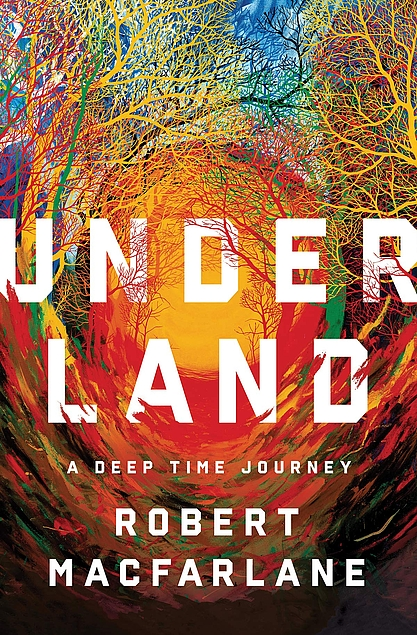
When I was eighteen years old, I hiked with my freshman anthropology class from the Hudson-Meng dig site to Toadstool Geological Park, out in Nebraska’s Panhandle. It was one of the longest, hottest hikes I have ever trekked, the first where I’d ever heard the blood-freezing bone-shake tambourine of a rattlesnake and her tail, mere feet away from where I stood, and where I, with only my own two legs, traveled back in time. It is one of my favorite memories. Standing in a mostly-dry riverbank, after crossing over the pale limestone gashes in the the grasslands, eyes raised to the multicolored strata of the earthen walls around me, I was beneath and surrounded by different ages of the Earth, upon which feet so like mine might have tread. There is nothing that makes you feel smaller, more connected, more human.
Robert Macfarlane’s Underland swept me back to that moment in a breathtaking work of nonfiction. His writing is crisp, lyrical, and heart-cuttingly honest. The mark of an experienced storyteller traces through each paragraph and page like the webs of fungi beneath earth’s forests, connecting and communicating and enriching his experiences and ideas. Whether he is describing the way colors and sound return to the self after exiting a cave system, or forcing his body to crawl inch by claustrophobic inch through an unstable tunnel scarcely bigger than himself, there is a breath-robbing sense of adventure and awe throughout his journey.
There is also the sense of a great ache; we are, he writes, and circles back to, in the midst of the Anthropocene – the geological epoch of human impact, to be noted in the strata of our planet when we are long gone, “what will survive of us is plastic, swine bones and lead-207, the stable isotope at the end of the uranium-235 decay chain” (77). But this is not a book of pessimism, nor of misanthropy, even as it turns its gaze to The Hiding Place, in Olkiluoto, Finland, where we prepare to seal our nuclear waste. This is not a place of honour, the inscription for that chamber begins – a deterrent for the generations we hope that will come after us. And it is with the hope in the generations of whatever life that will come that the work is being done, Macfarlane realizes.
“The same three tasks recur across cultures and epochs: to shelter what is precious, to yield what is valuable, and to dispose of what is harmful” (8). This is why we go down into the Earth, why it features so heavily in our mythologies across our cultures and ages — what we have buried is a part of us, a reflection of us, what we grieve and what we hope for and what we believe in, the unknown selves we wish to uncover. It is as much a part of our future as it is our past. Underland begins with analyzing our reflexive revulsion to the underlands, and then peels back the earth and uncovers beauty and an incredible, unfathomable stretch of time that goes far before us, and will carry on far after.
Macfarlane, Robert. Underland: A Deep Time Journey. W. W. Norton, 2019.
Friday Reads: Frankissstein: A Love Story, by Jeanette Winterson
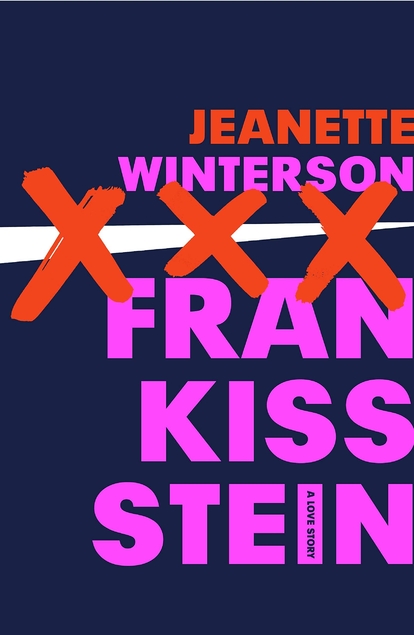
Frankissstein: A Love Story, by Jeanette Winterson, is just that: a love story.
What kind of love story, though, is the question. Love between whom? Love for what? That’s the question at the core of it.
The book is divided between two main intertwined narratives: the first set in history, that of young Mary Shelley, as she sparks with inspiration to pen the novel Frankenstein. The second narrative takes place in the near future, following Ry Shelley, a transgender doctor, and their journey alongside the mysterious man they have fallen in love with: Victor Stein. Victor, who is seeking to overcome death, not through stitching and reanimating a corpse, but with AI technology. Accompanying them are their parallels from both times: Lord Byron, the poet becomes Ron Lord, the sex-bot inventor/dealer (ha!); Dr. Polidori, Byron’s physician, becomes Polly D., a writer for Vanity Fair, and Claire Clairmont, Mary Shelley’s stepsister and Byron’s mistress, who becomes just Claire, a religious woman.
It’s a novel that was, largely, more philosophy than plot. Winterson’s stories are usually such — literary fiction; my all-time favorite book is her The Stone Gods — but this read almost like a thesis on what makes us human, the future of humanity, death, what our souls might be (if we even have one), gender, a smidge of socialism, reality, the ethics of AI/robotics, feminism… it was a lot packed into 344 pages. The interwoven narratives kept the book flowing, as did Winterson’s clever writing, as usual; though I did wrestle with choices she made, especially where Ry was concerned, choices that felt like amateur, insensitive mistakes. Overall, I loved Mary Shelley’s story more than I loved the pseudo-sci-fi story, even (or maybe because) I knew what happened in her life, tragedies and all. It was just the telling that varied. For me, that was where the love story shone through the brightest. Mary’s love and grief and curiosity were so well threaded together that she came alive on the page better than all the others, I felt, and was (re)animated for a little time with nothing more than a spark of imagination.
Frankissstein certainly isn’t Winterson’s most successful work, by any means, in my opinion, and unfortunately ended up feeling more like something like a work in process than a final product. And it definitely is no stellar crash-course in Trans 101; Ry is not understood by the characters that surround them in the narrative, which makes it challenging to see if they are understood by their author (who could have – should have – used non-binary instead of hybrid to describe them in-text), and so you feel for them, seemingly as displaced in the world as Dr. Frankenstein’s creation; a parallel, too, that perhaps is not the most kind; however, there is a great wealth of history of the queer and the creation, the queer and the monster. But the analysis one can pull from the text doesn’t fully make up for the discomforting wade through transphobia, and so if you’re interested in Winterson’s LGBTQ works rather than her musings on the human condition, another one of her earlier novels or her autobiography might be a better place to begin.
Winterson, Jeanette. Frankissstein. Grove Press, 2019.
Friday Reads: Things to Do When You’re Goth in the Country & Other Stories
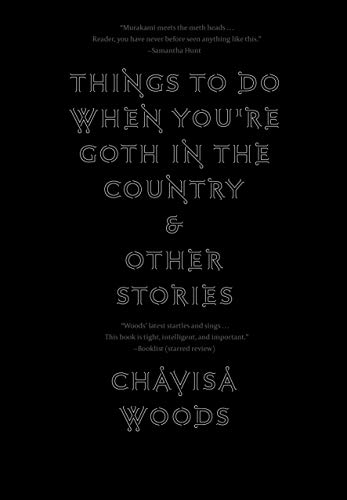
Things to Do When You’re Goth in the Country by Chavisa Woods is a collection of short fiction. Weird Stories. Liminal Stories. Queer Stories.
In the first, “How to Stop Smoking in Nineteen Thousand Two Hundred and Eighty-Seven Seconds, Usama,” a young New York lesbian returns to her rural hometown and strange things start happening: eerie lights in the woods, and a terrifying sense that everything is connected. In “Revelations,” a grieving widow’s friends tip her world upside down in an attempt to save the church she founded. And in the titular story, the narrator provides a sample menu of what they recommend one ought to do when one is Goth and living in the country: including, but not limited to, “a nonconsensual, surprise Southern Baptist exorcism. There’s just nothing else that can compete” (215).
At their cores, these eight stories are about two things: Being, and Doing, and all the contradictions and complications and messes that comes with all of that. To be both stuck and free. To be Goth – to be Queer – to be Outsider – to be of a place, born and raised; simultaneously claimed and unclaimed, known and unknown, liminal and with one foot always lifted and pointed and stepping somewhere else. But the other foot – the other foot, the one we love and hate in equal measure – is still rooted down and planted in the homesoil from which we grew. Woods tells these stories not with melancholy, and not even really with nostalgia, but with a casual shrug of honesty, an unflinching bluntness, and a dry snap of humor. Importantly, her characters don’t just exist, they act — in human, sad, rough-edged, transgressive and get-by ways. And what unfolds is a commentary on the larger nowhere places and strange spaces between friends, strangers, lovers and enemies in the Middle of Nowhere; where the corn rustles in the haunting thick of dark and the bone-thin coyotes laugh as you double-guess the shiver-trick question of movement in your rearview and press the gas a littler harder.
“This is where you belong. There is much to be done” (221).
This book is for mature audiences.
Looking for other unsettling books like this in the chilly prelude to Halloween this season? Here is what this author recommends: https://electricliterature.com/10-books-for-country-goths/
Woods, Chavisa. Things to Do When You’re Goth in the Country. Seven Stories Press, 2017.
Friday Reads: The Last Policeman
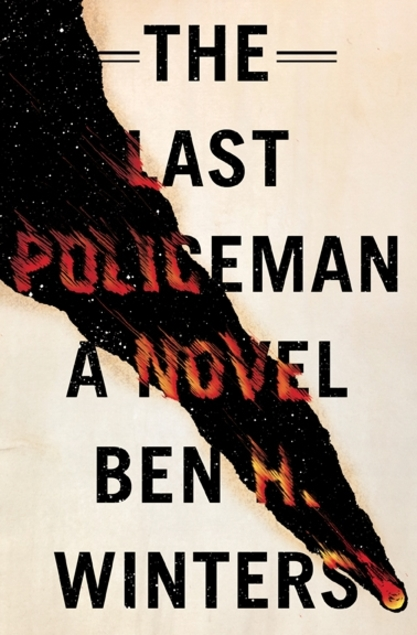 In six months’ time, an asteroid is going to slam into the Earth, ending all life as everyone knows it, and Detective Hank Palace just wants to do his job.
Peter Zell – actuary, ordinary, quiet man, fellow-waiter-for-the-End – is found dead in a McDonald’s bathroom. Suicide, of course. It must be, because all over Concord, and all over the world, people are killing themselves in a preemptive epidemic – it’s the end of the world, and things are beginning to get bad, and they’re only going to get worse before – BAM! – so why not get it out of the way sooner rather than later?
Only Hank – who wanted to be a detective since he was a kid, now, finally, has the chance; all around him people are walking off their jobs, because who wants to clock in when death, confirmed in odds and orbit is hurtling on a direct and unstoppable path towards your species’ sole habitable planet? And those people happen to include detectives, which means rookie cops get promoted years early, making Hank the luckiest, unluckiest man in Concord, depending on your perspective; hey kid, you made it, sorry about the asteroid. Ain’t the just the old sting of existential dread that comes with being a Millennial? – Only Hank isn’t so sure Peter Zell killed himself. Hank, still mostly bright-eyed, still dedicated, with Farley and Leonard’s Criminal Investigation’s textbook memorized, is pretty sure that Peter Zell was murdered.
The Last Policeman is not your everyday detective novel. The elements of a typical mystery are there: the suspects, the clues, the red herrings and the twists, the suspense that moves quick enough to have your spine straightening and your eyes brightening with quickened interest; did we get ‘em, did we figure it out? Remove the asteroid and you have a standard detective story: was a man murdered, and for what? Depending on who the man was, maybe there’s less dragging of feet. Put back the asteroid. Now a man is dead. Maybe murdered, maybe not; does it matter?
To Hank, it matters. He wants to know the story (175). He wants to do his job; a man is dead and that matters, even though they’re all going to die.
I love a good detective story, and if there’s a good, solid human element mixed with a literary style, then I am sold. Winters crafted a doomed world but kept Hank’s chin up enough despite, as one character calls it, “the weight of all this unbearable immanence” (39). It’s a complicated, bittersweet novel that surprised me by having bright moments of humor. Since it is the first in its trilogy, it left some threads dangling, and I am curious to see how Winters develops those plotlines. It is interesting to start a series where the end is pretty much a given – and not a particularly, one must assume, happy end. There was an element of denial I found myself falling into as I read. Because I – like Hank, like everyone – don’t want it to end like that.
Which creates a fascinating connection between the characters and the reader: to hope, in that ever-irrational, ever-human way, for an impossible way out; that somehow, someone failed to carry a one somewhere and threw the entire model off course; that at the last moment the asteroid is going to veer away and the disaster will be averted and we will all go on living.
The Last Policeman is followed by Countdown City and World of Trouble.
Winters, Ben H. The Last Policeman. Quirk Books, 2012.
Friday Reads: The Sound of a Wild Snail Eating by Elisabeth Tova Bailey
“I found a snail in the woods. I brought it back and it’s right here beneath the violets …”
“Is it alive?”
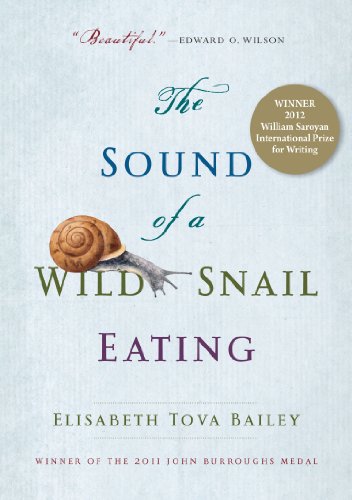
This is the first question Bailey asks of the snail in her book, The Sound of a Wild Snail Eating, in which she recounts her survival through a debilitating relapse of her chronic illness. Once a traveler and gardener, she is rendered bedbound and alone, save for the occasional visits of loved ones and her caregiver. And then she is gifted the company of a wild woodland snail, brought from its habitat with a friend’s potted offering of wild violets.
As it so happens, the snail is alive, and its motion and unique liveliness breathes purpose into Bailey’s stalled life.
The Sound of a Wild Snail Eating is a small book. Its pages number at 170; 191 if you count the acknowledgements and bibliography. It’s a quick read that gets technical at times but never becomes wholly inaccessible. Its style, complete with pages dotted here and there with monochrome drawings of snails, is a tribute to the 19th century naturalists of whom Bailey seems fond, and she follows in their footsteps – or, rather, to borrow her imagery, she glides along the slime trail they left behind.
Bailey draws from scientific literature and poetry in rhythm with her observations, making the book one-part informative essay and one-part ode. Peppered in between discussions of the snail’s locomotion, diet, and evolution are the chronicles of her illness, told in an almost tangential fashion, secondary but parallel to the snail’s life, where she both wishes to be more like the snail and longs to feel human again. Is it alive, she asks of the snail and its stillness during their first introduction. Am I alive, she seems to ask; or, the darker question that lingers, one with an answer she couldn’t know, will I survive this?
The Sound of a Wild Snail Eating is best enjoyed in the perfect stillness that might allow oneself to overhear a snail at its dinner. Bailey asks the reader to slow down and ponder – and wonder – at nature and its small, unnoticed creatures and their tiny, significant lives. The reward for your patience is a quiet sort of jubilation and a feeling of hopeful resilience.
Bailey invites us to consider the snail and, in doing so, asks if we might also see ourselves.
Bailey, Elisabeth Tova. The Sound of a Wild Snail Eating. Algonquin Books of Chapel Hill, 2010.

